
ThreatLocker
Stop Trusting Everything: Why Australian Businesses Are Turning to ThreatLocker

Why ThreatLocker Is Becoming Essential for Modern Cybersecurity
Stop Trusting Everything: Why Australian Businesses Are Turning to ThreatLocker
Cyber threats are evolving faster than ever. Ransomware, zero-day exploits, fileless malware, and software supply chain attacks continue to bypass traditional antivirus and endpoint protection solutions. The problem isn’t just malicious software—it’s that attackers increasingly abuse legitimate applications already running inside your environment.
That’s where ThreatLocker takes a different approach.
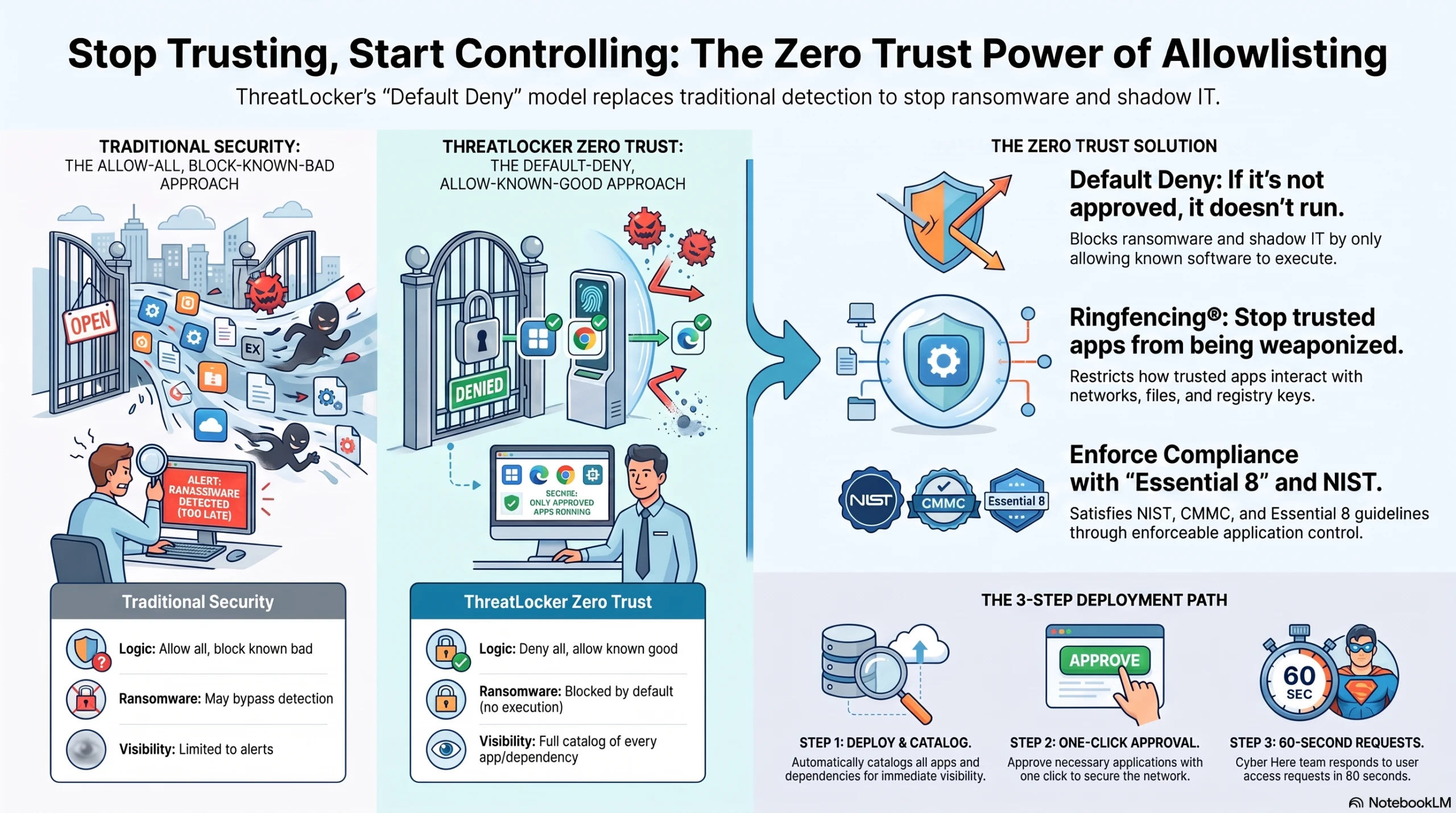
Rather than trying to identify and block every possible threat, ThreatLocker follows a Zero Trust security model: if an application isn’t explicitly approved, it doesn’t run. This powerful security strategy dramatically reduces an organisation’s attack surface and helps stop cyberattacks before they can start.
What Is ThreatLocker?
ThreatLocker is an endpoint security platform designed to give organisations complete control over what can run, what can access sensitive resources, and what users can do within their environment.
Unlike traditional security tools that primarily focus on detecting malicious activity after execution, ThreatLocker operates with a default deny philosophy. Only trusted applications, scripts, installers, and processes are allowed to execute. Everything else is automatically blocked.
Key ThreatLocker Features
Application Allowlisting
Application Allowlisting is the foundation of ThreatLocker’s security model.
Only approved applications can execute. If malware, ransomware, or unauthorised software attempts to run, it is blocked automatically.
Benefits include:
- Protection against unknown threats
- Prevention of shadow IT
- Reduced attack surface
- Greater visibility and control
- Improved compliance posture
Ringfencing®
One of ThreatLocker’s most powerful capabilities is Ringfencing.
Ringfencing places strict limitations on how trusted applications interact with other applications, files, networks, registry keys, and operating system resources.
For example:
- Microsoft Word can open documents but cannot launch PowerShell.
- PowerShell can run internal automation tasks but cannot access the internet.
- Applications can be prevented from accessing sensitive file locations or communicating with unauthorised systems.
Even if a trusted application is compromised, Ringfencing can prevent attackers from escalating privileges, moving laterally, or exfiltrating data.
Elevation Control
Many organisations struggle with users having excessive administrator privileges.
ThreatLocker Elevation Control enables businesses to:
- Remove unnecessary local administrator access
- Grant approved applications elevated permissions when required
- Improve security without disrupting productivity
Storage and Data Protection
ThreatLocker can also help control access to sensitive data by restricting which applications can read, write, copy, or modify files.
This reduces the risk of:
- Data breaches
- Accidental exposure
- Unauthorised data movement
- Ransomware encryption events

Why Australian Organisations Are Adopting a Zero Trust Approach
Australian businesses are facing increasing pressure from regulators, cyber insurers, and customers to improve cybersecurity resilience.
A Zero Trust security model assumes that no application, user, or process should be trusted automatically. ThreatLocker helps organisations implement this principle by enforcing strict controls on endpoints and reducing opportunities for attackers to exploit trusted software.
For businesses looking to strengthen their security posture while maintaining operational efficiency, ThreatLocker provides a practical way to reduce risk without adding complexity.
Real Business Benefits of ThreatLocker
Implementing ThreatLocker delivers more than stronger cybersecurity
Reduced Risk
By blocking unknown software and controlling application behaviour, organisations significantly reduce the likelihood of successful cyberattacks.
Better Compliance
ThreatLocker’s application control capabilities help organisations strengthen security governance and support compliance initiatives.
Greater Visibility
Security teams gain clear visibility into:
- Application activity
- User behaviour
- Software execution
- Policy violations
This makes it easier to identify risks before they become incidents.
Stronger Defence Against Ransomware
Application allowlisting and Ringfencing create multiple layers of protection designed to stop ransomware before encryption can begin.
Final Thoughts
Cybersecurity is no longer about identifying bad software—it’s about controlling what is allowed to operate within your environment.
ThreatLocker’s combination of Application Allowlisting, Ringfencing, Elevation Control, and Zero Trust principles provides organisations with powerful protection against modern cyber threats while delivering greater visibility and control over their IT environment.
As cybercriminals continue to exploit trusted applications and legitimate tools, adopting a proactive security strategy has never been more important.
Want to see how ThreatLocker could secure your organisation?
👉 Contact us today to schedule a cybersecurity assessment and discover how a Zero Trust approach can protect your business from ransomware, malware, and emerging cyber threats.