Microsoft 365 Copilot Use Cases by Department: Where SMBs Should Start

By alltasksIT | Managed Microsoft 365 & AI adoption for Australian SMBs 

John Koziaris
Chief Executive Officer

Copilot Audio overview

The short version

For SMBs, Microsoft 365 Copilot is most valuable when it is built into the work people already do every day: emails, meetings, documents, reports, proposals, onboarding, finance reviews, customer follow-up and internal knowledge sharing. It is not just another chatbot; it works across Word, Excel, PowerPoint, Outlook, Teams, SharePoint and Microsoft 365 Chat to reduce manual effort in familiar tools. 

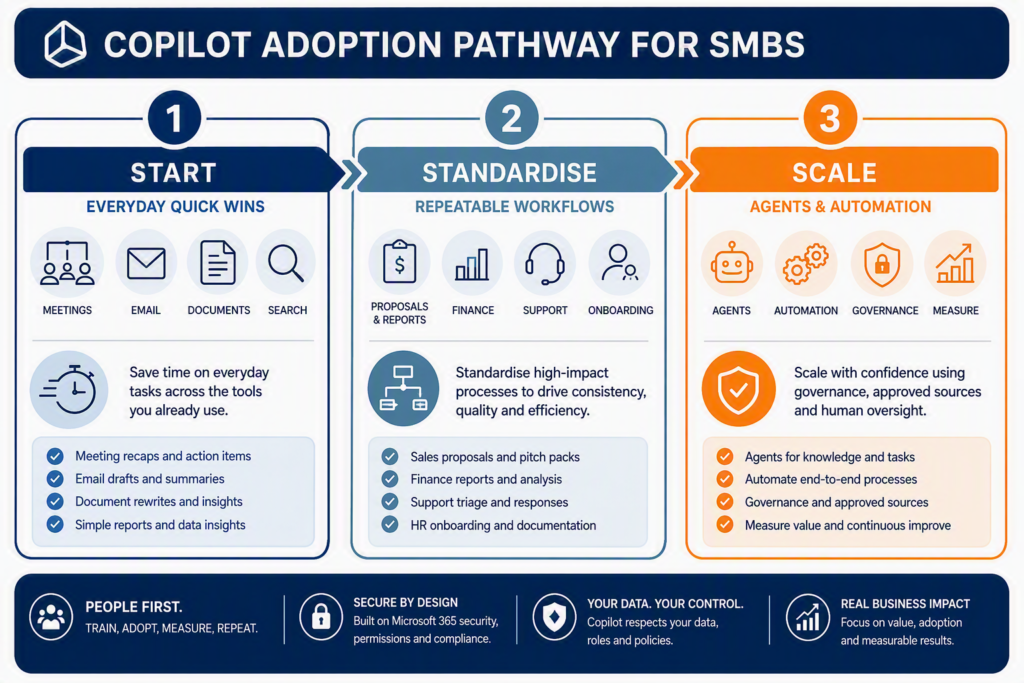
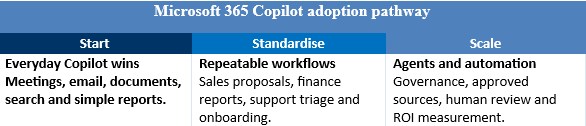
The practical adoption pattern for an SMB is simple: 

  1. Start with everyday quick wins such as meeting recaps, email drafts, document rewrites, PowerPoint packs, simple Excel insights and SharePoint search. 
  2. Move into repeatable department workflows such as sales proposals, marketing content, customer service triage, finance reporting, HR onboarding, operations updates and contract review. 
  3. Scale into agents and automation only after governance is ready, including permissions, data hygiene, sensitivity labels, approved content sources, human review and clear owners for each workflow. 

The evidence points in the same direction. Forrester’s SMB Total Economic Impact study, commissioned by Microsoft, modelled a 200-person SMB and projected 132%–353% ROI over three years, with gains across go-to-market, operations and people/culture. Microsoft customer stories also show value appearing in practical workflows such as content creation, customer feedback analysis, campaign briefs, sales decks, legal contract review and seller research. 

This guide is organised around real SMB adoption decisions: where to find quick wins, which business functions offer the best workflow opportunities, how Copilot can connect handovers between teams, when agents make sense, and what governance needs to be cleaned up before scaling. 

Use it as a starting menu rather than a complete rollout plan. Pick one painful, repeatable workflow, prove the value, train the right people, then expand safely across the business. 

A simple way to think about Copilot adoption is: quick wins first, repeatable workflows second, agents and automation third. Start with everyday productivity in Outlook, Teams, Word, Excel and PowerPoint. Then move into department processes such as sales proposals, finance reporting, onboarding and support triage. Only scale into agents once permissions, data governance, ownership and measurement are in place. 
Why this matters right now

Microsoft’s Work Trend Index found that 75% of knowledge workers were already using AI at work, 90% said it saved them time, and 78% were bringing their own AI tools to work — a figure that jumps to 80% in SMBs. 

Your staff are already using AI. The real question is whether that use is governed inside your Microsoft 365 tenant, or happening in unapproved consumer tools where client data may be exposed. 

That is why alltasksIT’s internal AI Policy names Microsoft Copilot for Microsoft 365 as our approved enterprise AI platform. It can be used to summarise documents and meetings, draft emails and internal content, and analyse internal data within existing permissions. Anything shared externally still needs human review first. 

Real businesses, real results

The proof is not just theoretical. Published Microsoft customer stories give SMBs useful reference points, although the results should be treated as examples rather than guaranteed outcomes: 

  • Morula Health — cut scientific content creation from weeks to days using Copilot in Word. ref 
  • PKSHA Technology — reduced customer feedback trend analysis from 3–4 hours to under 1 hour using Copilot in Teams and Excel.  ref 
  • Newman’s Own — created campaign briefs in ~30 minutes vs. up to 3 hours. ref 
  • Joos — used Copilot in PowerPoint to keep sales decks fresh and targeted per opportunity.  ref 
  • Vodafone — reported an average of 4 hours saved per user per week, including gains in legal contract review, before scaling Copilot from 300 to 68,000 users. ref 
  • Lumen Technologies — cut seller research from 4 hours to 15 minutes, and linked those 4 hours saved per seller per week to $50 million in revenue over 12 months. ref

For SMBs, the lesson is not to copy these organisations at the same scale. The practical takeaway is to start with one high-friction workflow, prove a measurable saving, and then decide whether the next use case is worth expanding. 

The common thread is simple: each organisation picked a painful, repeatable workflow, used Copilot to reduce the manual effort, measured the result, and then expanded from there. For an SMB, that might mean starting with one high-friction process such as proposal writing, customer feedback analysis, management reporting or contract review before moving into broader automation. 

Copilot use cases by business function

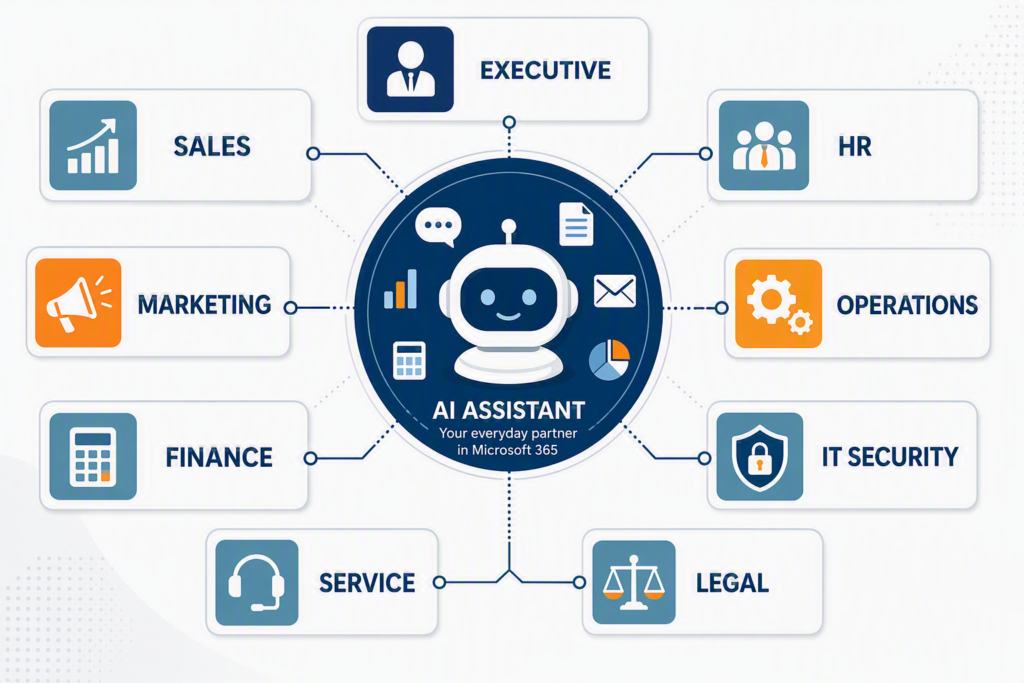
Think of the list below as a practical menu by department. If you are an owner wearing multiple hats, pick one useful workflow from each area and start there. 

The next section is designed to help owners and managers spot where Copilot can remove friction in everyday work. You do not need to start everywhere at once: choose the team with the clearest pain point, define the workflow, agree how success will be measured, and build confidence before expanding. 
Executive & strategy

  • Weekly CEO/owner briefing:  Microsoft 365 Chat pulls together emails, chats, meetings and documents into a Monday morning brief. 
  • Board and management packs: summarise trading updates, risks and finance commentary in Word, then generate the PowerPoint pack. 
  • Meeting catch-up and follow-up — Teams recaps for action items and decisions, Outlook drafts the follow-up email. 
  • Strategy research — Copilot Chat / Researcher pulls market, competitor and customer themes into a SWOT or options paper. 
  • Leadership communications: staff updates, customer notices and change announcements, tuned for the right audience. 
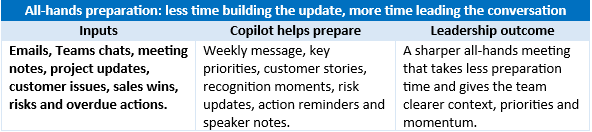
  • Create a weekly CEO briefing covering wins, risks, customer issues, major projects, financial highlights and overdue actions. 
  • Build a decision log that tracks what leadership agreed to over time. 
  • Identify recurring blockers that appear across meetings and emails. 

All-hands meeting preparation: use Copilot to update your all-hands template with wins, priorities, risks, customer stories and key messages for the week. 
Sales

  • Account research before outreach: summarise past emails, meetings and public information so sales teams can prepare in minutes instead of spending hours searching. 
  • Customer account review — review emails, meetings and tickets for a customer to identify upsell opportunities, renewal risks and products they are not currently using. 
  • Discovery call prep — generate tailored questions; use Teams recap for actions afterwards. 
  • Proposal and quote drafting — Word from meeting notes and prior proposal, Outlook covering email, PowerPoint summary. Forrester found 75% of SMB respondents experienced or expected more efficient proposal creation with Copilot. 
  • Sales deck personalisation — tailor decks by industry, pain point or persona. 
  • Renewal and upsell prep — summarise tickets, usage, QBRs and open risks into a renewal pack. 
  • Sales proposal agent: create an agent that helps draft proposals and quotes using approved templates, historical transactions and prior proposal content. 
  • Prospecting support: use Copilot to help identify target-market prospects, prepare outreach themes and summarise account research before first contact. 

Bid and tender response assistant 

  • Re-use content from previous tenders. 
  • Generate compliance response matrices. 
  • Identify unanswered requirements. 

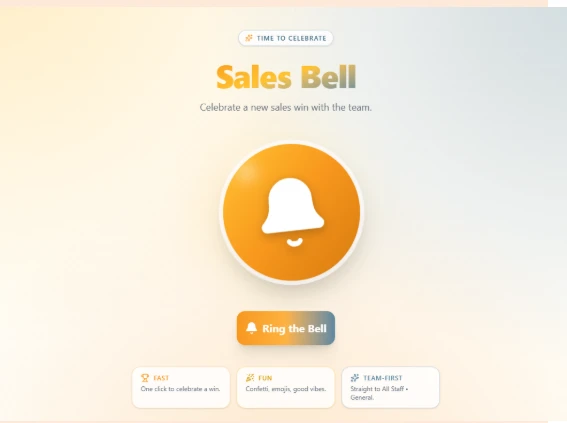
Create a sales bell with Agent Builder to announce wins in Teams

Sales bell

Tip: set up and use your Copilot Brand Kits. Copilot is improving at PowerPoint creation when brand assets and approved presentation styles are available. 

Marketing

  • Campaign brief creation: turn a product idea, webinar theme or sales priority into a clear campaign brief with the audience, message, channels, draft copy and follow-up actions. 
  • Content repurposing — turn one webinar or Teams transcript into a blog, newsletter and LinkedIn posts. 
  • One meeting becomes: 
    • Webinar summary 
    • Blog article 
    • LinkedIn posts 
    • Customer email 
    • Sales talking points 
    • FAQ 

One Webinar Becomes Many Assets 

Source 

Copilot helps create 

Business value 

Webinar or Teams meeting 

Transcript, recording, chat, questions and presentation notes. 

Webinar summary, blog article, newsletter story, LinkedIn posts, customer email, sales talking points and FAQ. 

Turns one event into a complete content pack, giving marketing, sales and customer success more value from the same source material. 

  • Market and competitor research — trend, segment and positioning summaries without agency spend. 
  • Branded presentations — Word brief → PowerPoint deck with speaker notes and brand kit applied. 
  • Customer voice analysis — Excel plus Copilot to theme surveys, reviews and NPS comments. 
  • Webinar planning and promotion — turn a webinar idea into a run sheet, landing page copy, email invitation, reminder emails, LinkedIn posts and follow-up sequence. 
  • Marketing calendar creation — build a monthly or quarterly content calendar from business priorities, seasonal themes, events, product launches and sales campaigns. 
  • SEO content planning — generate blog outlines, keyword themes, meta descriptions, FAQs and internal linking ideas for service pages or industry topics. 
  • Case study drafting — turn project notes, customer outcomes and sales input into a structured case study covering the problem, solution, result and customer value. 
  • Customer nurture emails — create nurture sequences for prospects, event attendees, existing clients or inactive customers, with different messages by stage or segment. 
  • Campaign performance summaries — use Copilot in Excel to summarise campaign results, compare channels, identify what worked and draft plain-English recommendations. 
  • Competitor battlecards — create simple sales and marketing battlecards that summarise competitor positioning, common objections, differentiators and suggested responses. 
  • Lead magnet creation — turn topics such as cybersecurity, Copilot readiness or cloud migration into checklists, guides, assessments, one-page PDFs or webinar handouts. 

Customer service and support

Customer Service and Support: From Issue to Improvement 

Workflow 

Copilot helps with 

Outcome 

Complaint response 

Summarise the customer history, previous emails, tickets and meeting notes, then draft a clear response and resolution plan. 

Faster, more consistent customer communication. 

Case triage 

Classify urgency, identify the likely topic, extract key details and suggest the right queue or owner. 

Less manual sorting and quicker routing. 

Knowledge-base assistance 

Pull approved SOPs, manuals, prior fixes and SharePoint knowledge so agents can answer faster. 

More accurate answers and less reliance on tribal knowledge. 

Feedback themes 

Summarise recurring complaints, ticket trends, survey comments and service issues. 

Issues are spotted before they become churn risks. 

Self-service FAQ agent 

Start with an internal FAQ over approved service documents, then expand externally once governance is mature. 

Customers and staff get quicker answers to common questions. 

QBR preparation 

Summarise tickets, service trends, risks, wins, open actions and improvement opportunities for the account review. 

More useful customer reviews with less preparation time. 

Finance

  • Monthly management reporting: use Copilot in Excel to review actuals, budgets and prior-month results, then draft plain-English commentary in Word and turn the key messages into a PowerPoint pack for leadership. For example, finance can ask Copilot to explain revenue, gross margin, payroll, overhead and cash movements in a way non-finance managers can understand. 
  • Variance analysis: identify the largest favourable and unfavourable variances by department, account, customer, project or location. Copilot can help highlight material movements, explain likely drivers, create charts, and draft commentary such as “software costs increased due to annual renewals” or “labour costs exceeded budget because project delivery hours were higher than planned”. 
  • Forecasting and scenario planning: speed up “what if” conversations around cash, hiring, pricing, debtor days, inventory and margin. Finance teams can model scenarios such as hiring two extra staff, delaying a major purchase, increasing prices by 3%, changing supplier costs, or testing the impact of slower customer payments on cash flow. 
  • Board-ready finance narrative: convert spreadsheets into a short decision-focused summary that explains what happened, why it matters, what risks need attention and what decisions are required. This is useful for board packs, shareholder updates, management meetings and monthly business reviews. 
  • AP checks and supplier risk: analyse supplier spend to flag duplicate invoices, repeated purchase amounts, unusual payment timing, new vendors, changed bank details, split invoices, or spend that has moved outside normal approval patterns. Copilot can help create a review list for finance before payments are released. 
  • AR and debtor follow-up: summarise overdue customers, identify patterns by customer, account manager or invoice type, and draft polite follow-up emails. Finance can also ask Copilot to group overdue amounts into ageing buckets and prepare a weekly debtor-risk summary for the leadership team. 
  • Unusual spending patterns: review expense data for unexpected increases, repeated small purchases, out-of-hours transactions, spend outside approved categories, or costs that have grown quietly over several months. This helps leaders catch leakage before it becomes a budget problem. 
  • Duplicate purchases and subscriptions: compare supplier, invoice, amount, description and renewal data to identify duplicate software subscriptions, double-paid invoices, overlapping licences or services being purchased by more than one department. 
  • Margin and pricing analysis: use Excel and Copilot to compare quoted margin, actual delivery cost, labour hours, discounts and supplier changes. This helps finance and sales understand which customers, products or services are profitable, and which require pricing, scope or delivery changes. 
  • Cash-flow visibility: prepare a rolling cash summary that brings together expected receipts, supplier payments, payroll, tax obligations, loan repayments and large upcoming purchases. Copilot can then draft a practical summary such as “cash is tight in week three due to payroll and insurance renewal timing”. 
  • Finance meeting preparation: create a weekly or monthly finance brief covering cash position, debtor risk, major variances, supplier issues, upcoming renewals, budget concerns and decisions required from management. 
  • Finance governance and human review: use Copilot to accelerate analysis, summaries and first drafts, but keep finance controls in place. Outputs should be checked against the source data, reviewed by the finance owner, and never used as the final authority for payments, forecasts, tax, audit or board reporting without human validation.

Example: a future week in the life of a Financial Controller with Copilot

A Financial Controller’s week could look very different with Copilot embedded into everyday finance work. Monday starts with Copilot summarising the previous week’s cash movement, overdue debtors, supplier payments, upcoming payroll commitments and any budget exceptions that need attention. By Tuesday, it has helped review the month-to-date results in Excel, flagging unusual spend, margin movement, duplicate invoice risks and variances that need explanation. Wednesday is focused on business partnering: Copilot turns the numbers into plain-English talking points for department managers, drafts follow-up questions, and helps prepare scenarios such as the cash impact of new hires, delayed customer payments or supplier price increases. On Thursday, the Financial Controller uses Copilot to prepare the leadership finance brief, converting spreadsheets into a decision-focused narrative covering performance, risks, assumptions and actions. By Friday, Copilot has helped update the board pack, draft debtor follow-up emails, summarise open finance actions from Teams meetings, and create a short “next week” checklist. The Financial Controller still owns the judgement, controls and final review, but less time is spent pulling information together and more time is spent advising the business. 

Operations

  • Daily and weekly operations brief: consolidate Teams conversations, Outlook updates, open actions, blockers and customer issues into one practical operations update so managers can see what needs attention without chasing multiple channels. 
  • Root cause analysis: use Copilot to analyse incident data, meeting notes and Excel trends, draft the RCA in Word, and create a short executive summary that explains what happened, why it happened, what changed and how the issue will be prevented next time. 
  • SOP and process documentation: convert notes, meeting outcomes and working instructions into checklists, process maps, training material and onboarding guides so repeatable work is easier to delegate, audit and improve. 
  • Project Management: Create workplans, scoping, managing projects. Copilot works with planner to create project plans. 
  • Inventory and product data clean-up: use Excel Copilot to consolidate product specifications, remove duplicates, standardise naming conventions and identify missing fields so reporting, purchasing and customer quoting are based on cleaner data. 
  • Multi-source reporting: build repeatable monthly reports that combine operational data from Excel, SharePoint, Teams, customer systems or line-of-business tools, with human review to validate accuracy, add context and turn the numbers into action. 
  • Capacity and workload planning: summarise project demand, team availability, open actions and recurring operational bottlenecks so managers can identify pressure points before they affect service quality or delivery timelines. 
  • Supplier and procurement follow-up: summarise vendor emails, quotes, order status, backorders and delivery delays so operations teams can track what is outstanding and communicate delays before they become customer issues. 
  • Create an operations SharePoint agent that becomes an expert on a specific department, site or process area, helping staff find approved procedures, forms, policies, contact points and reference material without searching through folders. 
    • Operations SOP Agent 
    • Site Operations Agent 
    • Procurement and Inventory Agent 
  • Users can ask plain-English questions about approved operations material instead of searching through folders, old emails or disconnected documents. 
    • “What is the approved process for replacing customer equipment?” 
    • “Where is the latest stock ordering checklist?” 
    • “What steps are required before closing an operational incident?” 

Useful operations prompts: ask questions that surface risks, customer pressure points and recurring leadership themes.

  • “What are the biggest operational risks discussed in the last 30 days?” 
  • “Which customers have required the most executive attention this quarter?” 
  • “What themes are appearing most often in leadership meetings?” 

Health and Safety

  • OH&S induction material: create health and safety induction guides, checklists, toolbox talks, quizzes and role-specific safety reminders from approved policies and procedures.  
  • Branded safety videos: use Copilot to draft a script, storyboard and presentation-style induction video using your brand kit, helping deliver consistent safety messaging to staff, contractors and visitors. 

HR and people

  • Job descriptions and ads: draft role descriptions and job advertisements from role notes, company values and approved position requirements. 
  • Candidate summaries and interview questions: summarise resumes into a consistent format and generate interview questions aligned to the role, helping hiring managers prepare faster. 
  • Review Candidates: ask Copilot to compare candidate resumes against the job description and produce a structured comparison table showing strengths, gaps and suggested follow-up questions. A human should still make the final decision. 
  • Onboarding packs: create first-week plans, checklists, welcome messages, role expectations, key contacts and training links. Microsoft and Forrester research cites up to 25% faster onboarding as a potential benefit. 
  • Employee self-service: create a policy and benefits Q&A agent over approved HR documents so staff can ask common questions about leave, expenses, benefits, policies and procedures without waiting for HR. 
  • Learning and development:  generate role-based learning recommendations, training pathways and skills checklists using existing role descriptions, performance goals and approved learning material. 
  • SharePoint Portals: use Copilot to help prepare a SharePoint site for new staff with key contacts, organisation charts, FAQs, policy documents, procedures, training content and welcome resources.
  • Handover documents: ask Copilot to prepare a structured handover document for a new team leader or manager by summarising relevant emails, meetings, chats and documents. This can reduce knowledge loss when people change roles or leave the business. 
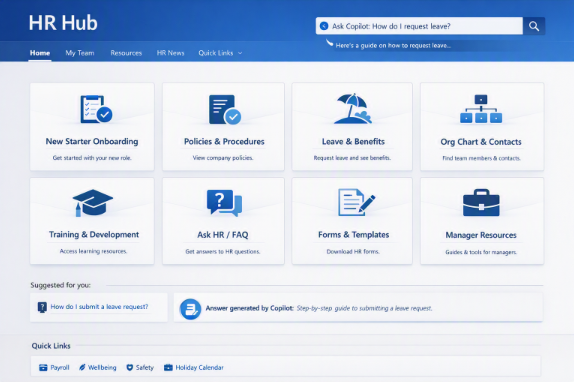
Example HR SharePoint hub: one front door for onboarding, policies, training, employee self-service and manager resources.

Ask Copilot to analyse:

  • Emails 
  • Teams chats 
  • Meeting notes 
  • Documents 

And produce: 

  • Process documentation 
  • Customer relationship summaries 
  • Key contacts 
  • Outstanding commitments 

    This dramatically reduces knowledge loss during staff turnover. 

The Secret Weapon Behind Our Fun Friday Kahoots: Microsoft Copilot

At alltasksIT, our Fun Friday Kahoots have become more than just a quiz. They are a chance for the team to laugh, learn something new, share a few inside jokes, and strengthen the connections that make a great workplace culture. As anyone who has ever hosted a Kahoot knows, however, coming up with fresh questions every week can take a surprising amount of time. 

That’s where Microsoft Copilot comes in. 

Copilot has become our behind-the-scenes assistant, helping transform a task that could take hours into something we can pull together in minutes. Rather than staring at a blank screen wondering what this week’s quiz should be about, we can ask Copilot to generate ideas around quirky world news, technology trends, cybersecurity topics, Australian trivia, or even MSP-themed scenarios. Microsoft describes Copilot as a tool that helps users create content, draft ideas, and automate repetitive work so they can focus on higher-value activities. 

The Secret Weapon Behind Our Fun Friday Kahoots: Microsoft Copilot

IT, security and governance

  • Copilot readiness review: before rollout, review Microsoft 365 permissions, SharePoint sharing, overshared files, sensitivity labels and access controls. Copilot respects existing user permissions, which means it does not create new access, but it can make poorly governed or overshared information much easier to find. A readiness review helps reduce this risk before users start relying on Copilot day to day. Microsoft’s guidance recommends remediating oversharing, setting guardrails and using sensitivity labels as part of a secure Copilot foundation.  
  • Helpdesk triage and knowledge-base summaries: Copilot can help service teams summarise incoming tickets, identify urgency, extract key details and suggest likely next steps based on previous support notes or knowledge-base articles. It can also turn solved tickets into draft KB articles, helping support teams build better documentation over time instead of relying on repeated tribal knowledge.  
  • Incident communications: during outages or service disruptions, Copilot can quickly draft internal updates, customer notices, executive summaries and post-incident reports. This helps keep communication consistent while engineers focus on resolving the issue. After the incident, Copilot can turn meeting notes, ticket history and timeline details into a plain-English summary covering what happened, impact, resolution and prevention actions. 
  • Security policy and safe-AI training: Copilot can help convert technical security policies into practical staff training material. For example, it can produce Word-based guidance, PowerPoint training decks, quiz questions, manager briefing notes and role-specific examples that explain how staff should use AI safely. This is useful for educating teams on approved AI tools, data handling, client confidentiality and when human review is required. 
  • AI policy videos and documents: use Copilot to create an AI policy in multiple formats, including a formal policy document, a short staff guide, FAQs, presentation slides, video scripts and branded training content. This helps ensure staff understand not only what the policy says, but how it applies in everyday work such as summarising emails, drafting client content, analysing documents or using customer data. 

Legal, compliance and contracts

  • Contract review summaries: use Copilot to create a first-pass summary of key clauses, obligations, renewal dates, notice periods, pricing changes, termination rights and commercial risks so leaders can review contracts faster before involving legal advisers where needed. 
  • Legal document libraries: use SharePoint as the central location for contracts, policies, legal templates, board papers, matter files and compliance evidence so legal content is easier to govern, search and reuse. 
  • Metadata and contract tagging: Auto tag documents with fields such as agreement type, supplier or customer, renewal date, notice period, owner, status, jurisdiction, risk level and confidentiality rating so Copilot and SharePoint views can surface the right information faster. 
  • Renewal and expiry tracking: create SharePoint views for contracts expiring in 30, 60 or 90 days, then use Copilot to summarise upcoming renewals, key obligations and risks that need attention. 
  • Legal knowledge retrieval: allow approved users to ask questions across SharePoint content, such as where the latest NDA template is, which supplier agreements are due for renewal, or what policy applies to a specific situation. 
  • Template and clause management: maintain approved templates for NDAs, MSAs, supplier agreements, privacy notices and policies, with metadata showing version, owner, approval status and last review date. 
  • Document approval workflows: use SharePoint approvals and Power Automate to route legal documents for review, approval and publishing, with Copilot helping draft reviewer notes, summaries and change explanations. 
  • Policy updates: compare current policies against new regulatory, industry or client requirements, summarise what has changed, highlight gaps and draft an updated version for review and approval. 
  • Compliance evidence packs: gather relevant emails, policies, actions, meeting notes and supporting documents into an audit-ready summary that shows what was requested, what evidence exists and what follow-up actions remain. 
  • Audit-ready evidence libraries: structure SharePoint libraries by control, obligation, audit area or client requirement so Copilot can help summarise available evidence and identify missing follow-up items. 
  • Risk and obligation registers: extract key obligations, owners, due dates and open risks from contracts, policies and meeting notes into a structured SharePoint list so nothing is missed between reviews. 
  • Matter or contract workspace summaries: use Copilot to summarise the documents, emails, notes and actions stored in a SharePoint site or Teams channel for a specific matter, contract, project or client. 
  • Legal knowledge agent: create a SharePoint-based agent over approved legal templates, policies and FAQs so staff can ask basic internal questions without emailing legal for every request. 
  • Contract request intake agent: guide staff through the information needed to request a new contract, NDA or review, then create a structured request for the legal team. 
  • Legal review guardrails: use Copilot for drafting support and internal preparation only. Legal, compliance and contract outputs should always be checked by the appropriate internal owner or external adviser before being relied on, approved or sent outside the business. 

Where Copilot connects the business

The biggest Copilot wins for SMBs often happen between teams, not inside a single app. This is where handovers slow down, context gets lost and leaders struggle to see what is really happening. Copilot can turn those messy handoffs into cleaner, faster and more visible workflows. 

  • Lead to sale: sales researches the account and prepares the proposal, finance checks pricing and margin, operations confirms capacity, and service receives a clean handover so the customer experience does not restart after the deal is won. 
  • Customer onboarding: turn the sales handover into an operations checklist, finance setup, service welcome and Teams kick-off recap so every new customer starts with clear actions and owners. 
  • Monthly business review: use Copilot to analyse Excel actuals, draft plain-English commentary, create a PowerPoint pack and capture Teams actions so leadership can move from numbers to decisions faster. 
  • Complaint to improvement: summarise the complaint, escalate it in Teams, check the knowledge base, draft the response, analyse trends and assign corrective actions so recurring issues are fixed rather than handled one at a time. 
  • Copilot governance rollout: IT reviews permissions, leadership chooses priority scenarios, champions test real workflows, finance measures ROI, and HR or operations trains staff so adoption is safe, practical and measurable. 

The takeaway: do not only ask where Copilot can save one person time. Ask where it can reduce handover friction, improve visibility and remove repeatable delays from the business
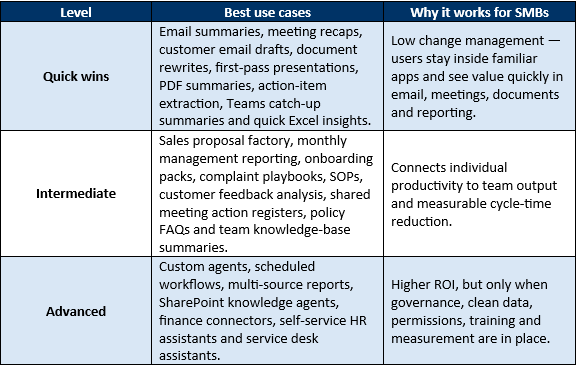
Quick wins vs advanced use cases

A good rule of thumb is to start with workflows people already do every week: summarising meetings, catching up on missed conversations, drafting customer emails, rewriting documents, preparing simple reports and finding information in SharePoint. These wins are easy to demonstrate and help build confidence before moving into agents and automation. 

Three rules for getting real Copilot ROI

Across our SMB work in Australia, and in line with Microsoft’s own adoption guidance, three rules consistently separate successful Copilot rollouts from wasted licence spend

  • Don’t spray licences; assign them intentionally. Give access to whole teams, not isolated individuals, so people learn together and apply Copilot to shared workflows. Use an AI council, a champion community and the Copilot Dashboard to guide adoption and measure whether licences are being used well. 
  • Start where the work is already painful. Look for inbox overload, meeting overload, proposal creation, reporting, onboarding and customer response delays. Pick one workflow per department, measure the baseline, improve the process, publish the win, then expand. 
  • Put governance in place before you scale. Copilot inherits existing Microsoft 365 permissions, so it does not create new access by itself, but it can make overshared information much easier to find. Clean up data hygiene, permissions and sensitivity labels first so adoption is safe, trusted and scalable. 


The practical test is simple: if a use case cannot be tied to a real workflow, a clear owner and a measurable outcome, it is not ready to scale. 

Where alltasksIT fits in

We help Australian SMBs move beyond simply buying Copilot licences and turn them into measurable productivity gains, safely and with the right governance in place. 

Our SMB Copilot engagements typically cover: 

  • Copilot readiness review:  permissions, oversharing, sensitivity labels and governance guardrails. 
  • Scenario selection:  picking the 3–5 workflows most likely to pay back your licence spend. 
  • Champion enablement:  training the small internal team who’ll drive adoption after we leave. 
  • Adoption measurement:  using the Copilot Dashboard to prove ROI and identify unused seats. 
  • Agent and automation strategy: when to graduate from Copilot chat to purpose-built agents. 

If you would like a 30-minute Copilot readiness conversation, we can help identify the best starting workflows, check whether your Microsoft 365 tenant is ready, and map a safe path from quick wins to measurable ROI. 

Frequently Asked Questions

What is Microsoft 365 Copilot?

Microsoft 365 Copilot is an AI assistant built into Microsoft 365 apps such as Word, Excel, PowerPoint, Outlook, Teams and Microsoft 365 Chat. It helps users summarise information, draft content, analyse data, prepare meetings and find answers from approved business content while respecting existing Microsoft 365 permissions.

Is Microsoft 365 Copilot suitable for small and medium businesses?

Yes. Copilot is well suited to SMBs when it is introduced with a clear adoption plan. The best starting point is usually everyday work such as email, meetings, reports, proposals, customer follow-up, onboarding and internal knowledge search, before moving into advanced agents and automation.

Where should an SMB start with Microsoft 365 Copilot?

Start with one painful, repeatable workflow where people already lose time every week. Good first use cases include Teams meeting recaps, Outlook email summaries, Word document rewrites, PowerPoint draft packs, Excel commentary and SharePoint knowledge search. Once the team can show a measurable improvement, expand to the next workflow.

How does Copilot help improve ROI for SMBs?

Copilot improves ROI when it reduces time spent on repeatable manual work and helps teams produce better outputs faster. Examples include faster proposal creation, shorter meeting follow-up cycles, clearer finance commentary, quicker customer responses, easier onboarding and less time searching for information across Microsoft 365.

What governance is needed before rolling out Copilot?

Before enabling Copilot broadly, businesses should review SharePoint and OneDrive permissions, external sharing, sensitivity labels, data loss prevention, guest access, retention settings and AI acceptable-use policies. Copilot does not create new access, but it can make existing overshared information easier to find.

What are the most practical Copilot use cases for Australian SMBs?

The most practical use cases are meeting summaries, email drafting, customer communication, sales proposals, marketing content, finance reporting, HR onboarding, policy FAQs, contract summaries, service desk triage and internal knowledge-base search. These use cases work because they sit inside tools staff already use every day.

Do SMBs need agents, or should they start with standard Copilot?

Most SMBs should start with standard Copilot use cases first. Agents make sense once the business has clean data, clear ownership, approved content sources, strong permissions and a repeatable workflow that is worth automating or turning into a self-service experience.

How can alltasksIT help with Microsoft 365 Copilot adoption?

alltasksIT helps Australian SMBs assess Copilot readiness, clean up permissions, choose the right use cases, train champions, create safe AI policies, measure adoption and plan future agents or automation. The goal is to turn Copilot licences into measurable business value, not just another unused subscription.

Would you like a 30-minute Copilot readiness conversation?

We can help identify the best starting workflows, check whether your Microsoft 365 tenant is ready, and map a safe path from quick wins to measurable ROI. 
Complete the form and our team will contact you to discuss your environment .

Author

John Koziaris

CEO/Founder

Founder and Principal of alltasksIT with 30+ years IT experience, John has a broad and varied experience across cloud computing strategies.

John has been successfully realising IT and networking solutions for small to medium businesses for over 25 years.